The first time I lost a lot of weight, I treated the goal almost like a campaign with one very obvious KPI: make the number on the scale go down.
It worked. For a while.
I pushed hard, used aggressive dieting and high-effort exercise, and eventually lost around 30kg. The number moved quickly enough that it felt like proof the approach was working.
Then I regained much of the weight later.
A metric can improve while the system behind it is becoming harder to sustain.
01
A good KPI can still become a bad objective
Weight is useful because it is simple. Step on a scale and you get a number. The problem was that I started treating that number as the whole objective.
If the scale moved down, I was succeeding. If it did not, I felt like something was wrong.
That encouraged decisions that were effective in the short term but difficult to maintain. I could push harder, eat less and add more exercise. The KPI responded. But the approach did not necessarily improve everything I actually cared about.
Make body weight go down.
Build a healthier body and a system I can realistically sustain.
That distinction now feels familiar from marketing. Leads, followers, impressions and revenue can all be useful metrics. But once a metric becomes the objective by itself, it can start driving the wrong behaviour.
02
Short-term optimisation can hide a long-term problem
The first approach was very good at creating visible short-term movement. It was much less successful at creating something I could live with indefinitely.
When the system became too restrictive, eventually I stopped following it. Once that happened, the progress did not have much protection behind it.
That changed how I think about sustainability. A slower method that survives real life can be more valuable than an aggressive method that produces a better-looking monthly report and then collapses.
The fastest route to a milestone is not always the best route to keeping the result.
03
One number rarely tells the whole story
When I started rebuilding my approach, I became less interested in treating the scale as the only source of truth.
Strength, how clothes fit, waist changes, photographs, energy and what I can physically do all started to matter more. Sometimes body weight can stay stubborn while other indicators are moving in the right direction.
That does not make the scale useless. It just makes it one signal among several.
The scale did not move, so there was no progress.
Weight, strength, waist, photos, clothes and consistency can tell a more complete story together.
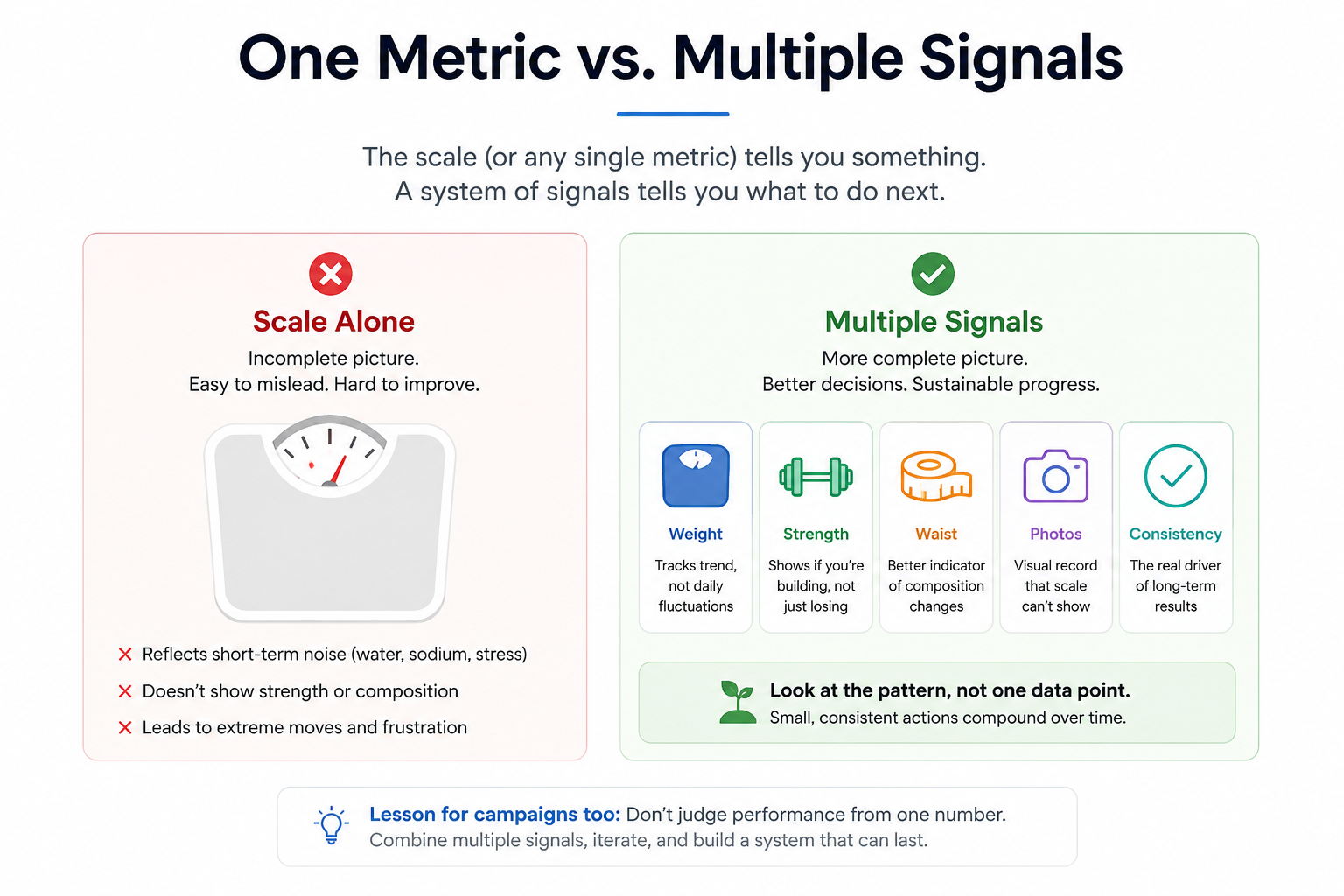
Marketing has the same problem. One dashboard number can make performance look excellent or terrible depending on what it leaves out.
04
Iteration is different from constantly changing direction
My current approach is less dramatic. I make smaller adjustments, watch what happens, and give the system enough time to show whether it is working.
That also means resisting the temptation to rewrite the plan every time one measurement disappoints me.
There is a difference between learning from data and reacting emotionally to data.
- Set the real objective. Decide what success actually means beyond the easiest number to measure.
- Choose several useful signals. No single metric should carry the entire judgement.
- Give the system enough time. Normal variation should not force a strategy change every week.
- Adjust deliberately. Change something because the evidence supports it, not because one bad reading feels uncomfortable.
The system is part of the result
I used to think the successful version of the story was the one where I lost the most weight the fastest.
Now I think the more useful question is whether I can build a process that still works when motivation is average, work gets busy and progress is less exciting.
That is probably the biggest lesson I carried back into marketing.
A strategy is not good only because it can produce a result once. The system used to create that result matters too, especially if you expect to keep doing it after the initial burst of motivation, budget or attention disappears.
Sustainable progress is not the slower version of success. Sometimes it is the part that makes success last.