I started ericlow.my for a pretty simple reason.
I wanted my own professional site.
Something that could pull together my career, selected work, thoughts and speaking experience without costing much to run.
That was really it.
But somewhere between setting up Search Console, GA4, the sitemap and watching the first few pages get indexed, I realised I had accidentally built something more useful.
A small SEO and GEO petri dish.
A place where I can test things properly without needing a big budget, a vendor, or a long approval process.
And that part has become more interesting to me than the website itself.
01
I wanted to see how far I could go without spending much
I deliberately kept the setup cheap.
I bought the domain, put the code on GitHub and deployed it using Cloudflare Pages.
For a site like mine, I do not need a database, membership system or anything complicated. I just need the site to load properly and stay online.
So part of the experiment was simply seeing how far I could take it with very little infrastructure cost.
Quite far, apparently.
And because the cost is low, I can afford to experiment.
If I tweak something and nothing happens, fine.
I did not burn a big budget learning that.
02
Website builders were a no for me
I did look at Wix and Squarespace.
They are convenient. I get why people use them.
But for God's sake, I am a marketer. Of course I was going to obsess over how the story was presented.
The problem I had with website builders was not that they were bad.
They were just too constrained for what I wanted.
You pick a template, then slowly start fitting your story into the template.
Hero section. A few cards. Some stats. Maybe testimonials. Contact form.
After a while, everything starts looking a bit too familiar.
I did not want my site to look like somebody else's polished template with my name swapped in.
If something felt too much like a résumé, I wanted to rebuild it.
If a page made me look like I was selling consulting services when I was not, I wanted to remove that whole idea.
If the flow was wrong, I wanted to move things around until it made sense.
AI-assisted coding gave me much more freedom to do that.
Instead of forcing my content into a template, I could shape the site around the story.
That mattered more to me.
I wanted the site to follow the story, not force the story into a template.
AI made the technical side easier.
It definitely did not make the decisions for me.
03
Search Console and GA4 changed the way I looked at the site
Before launch, I set up Google Search Console and GA4.
At the time, it was just another checklist item: sitemap checked, indexing checked, analytics checked.
It wasn't until the data started coming in that I realised this was where the site could actually become useful.
Instead of tweaking things because something felt off, I could watch what was really happening.
Was Google finding the pages? Which ones were getting impressions, and where was the traffic actually coming from?
If I posted on LinkedIn, did people click through? And once they landed, what did they do next, did they stop at the homepage, head to Career, or check out Selected Work?
That's far more useful than rearranging sections for the tenth time because something didn't feel right.
Now V2 can be driven by evidence instead of boredom.
04
That is when I realised I had built a petri dish
Once the site was live, the idea became pretty obvious.
I had a small environment that I fully controlled.
So why not use it?
Over the next 6 to 12 months, I want to test things like:
- article structure
- internal linking
- titles and descriptions
- indexing behaviour
- which topics start getting impressions
- whether LinkedIn activity helps discovery
- whether external references make a difference
- which content starts earning organic traffic
And then there is GEO, the newer part.
I want to understand how AI-driven discovery actually behaves. Does clearer authorship help, and do first-hand examples carry more weight than generic commentary?
I am also curious whether linking my name consistently with real companies, projects and industry organisations builds context that search engines and AI systems can pick up on, and whether traditional search visibility feeds into AI visibility too.
I do not know all the answers yet.
That is exactly why I want to test it.
05
The goal is not to become famous from my personal website
Of course I want people to find the site.
I did not build it so nobody would see it.
But traffic is not really the main prize.
The bigger goal is to sharpen my SEO and GEO skills through something real.
A personal website gives me the freedom to fail cheaply.
I can change an article.
I can tweak an internal link.
I can test a different title.
I can look at Search Console.
I can look at GA4.
If nothing happens, no big deal.
If something works, then I have learned something I can use somewhere more important.
06
That is where the corporate site comes in
This is probably the part I care about most.
I am not trying to become better at SEO and GEO just so ericlow.my gets more traffic.
The real goal is to take what I learn and apply it back to the corporate website and content work I manage.
My corporate work gives me the real-world material.
Real projects.
Real customer problems.
Real marketing decisions.
Real industry context.
My personal site gives me a place to experiment with how those ideas are structured, linked, measured and discovered.
The two can support each other naturally.
Not by manufacturing backlinks.
Not by trying to game search engines.
Just because there is a genuine relationship between the company, the work, the person and the experience behind the content.
That is the interesting part to me.
07
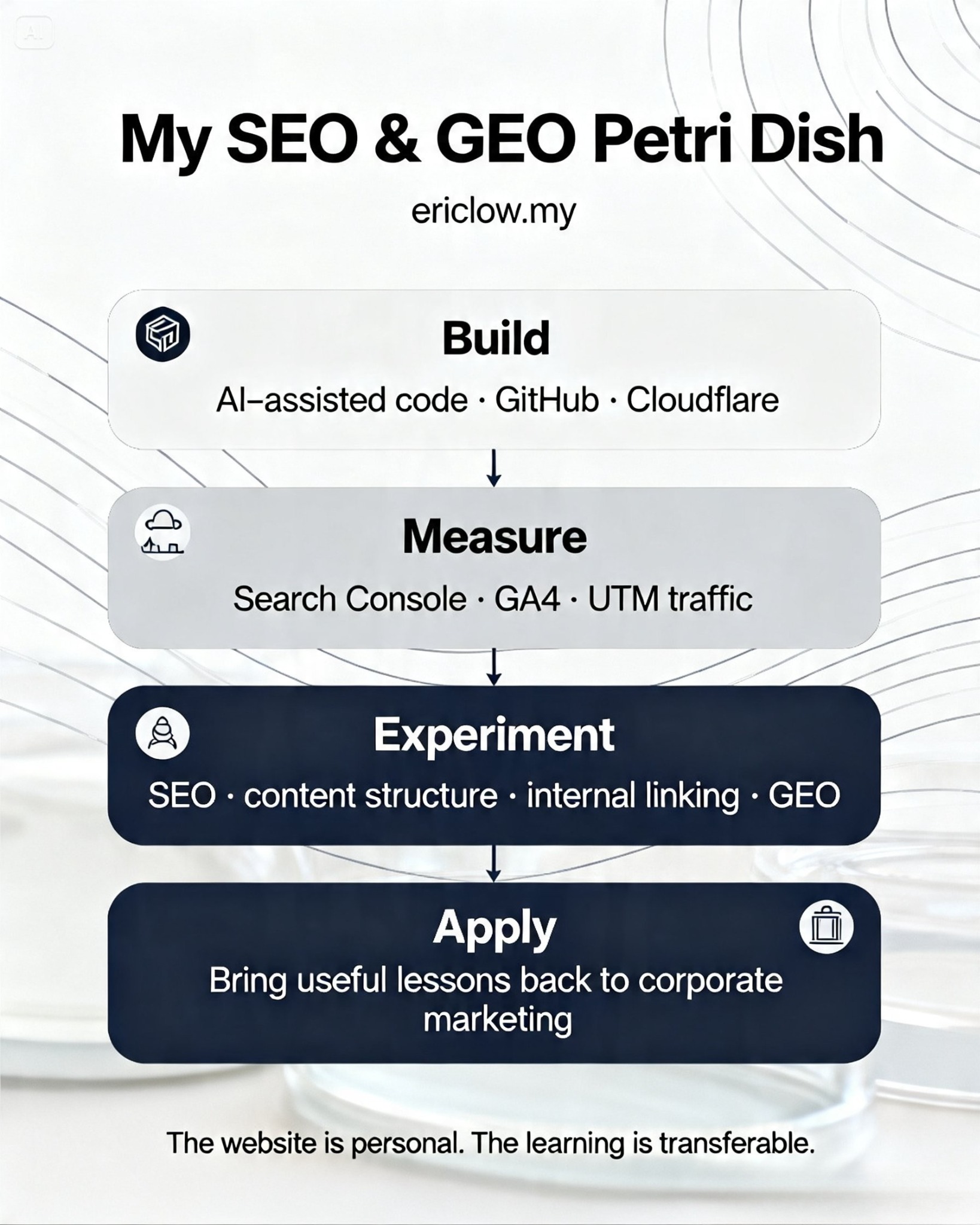
Build. Measure. Experiment. Apply.
That is basically what the site has become.
Build
Keep the setup cheap and flexible.
Measure
Use Search Console, GA4 and proper campaign tracking.
Experiment
Test SEO, content structure, internal linking and GEO.
Apply
Take the useful lessons back into corporate marketing.
I started the project because I wanted a personal website.
Now I am much more interested in what the website can teach me.
The traffic can grow slowly.
The SEO can take time.
Some experiments will work.
Some will probably do absolutely nothing.
That is fine.
Because the point is not just to make one website rank.
It is to get better at understanding the system behind it.
The website is personal. The learning is transferable.