I often tell my subordinate to throw me under the bus.
Especially when he is dealing with vendors.
If he needs to push back, reject an idea, ask for another round of changes, or have an uncomfortable conversation, I am perfectly happy for him to say: “My manager wants this changed.”
In other words, use me as the bad cop.
And I mean it. This is not a one-off trick. I want my team to know they can use me as the bad cop whenever it helps them manage the relationship properly.
It sounds funny, but there is a reason behind it.
Delegation means actually managing the relationship
When I hand a vendor relationship to someone on my team, I want them to manage it. Not just forward emails. Not just relay messages between the vendor and me.
Actually manage it.
That means handling the discussions, making day-to-day decisions, pushing back when necessary, and learning how to navigate the awkward parts.
For that to happen, I need to create a little separation between myself and the vendor.
What happens when I get too involved
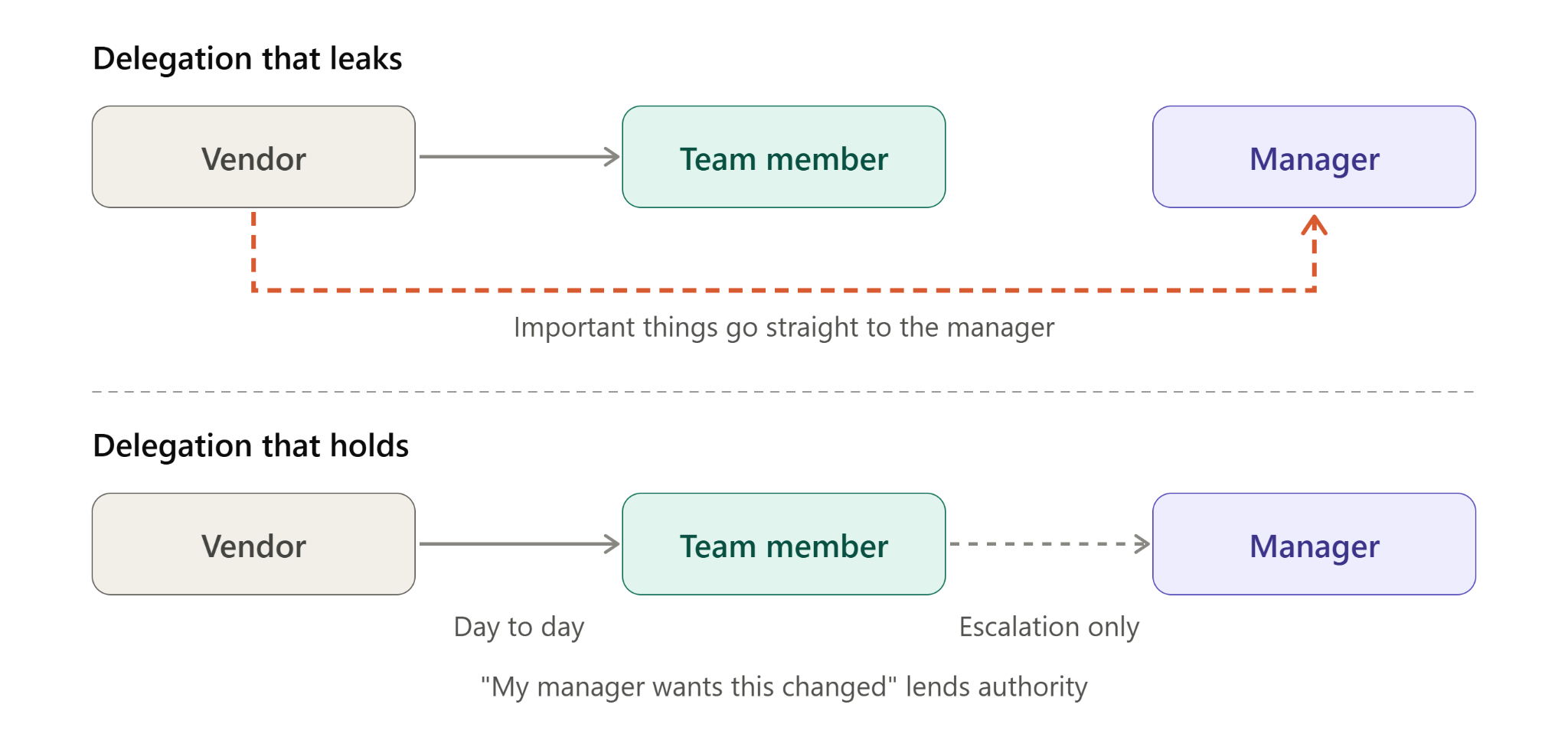
If I become too involved, something very predictable happens: the vendor starts coming directly to me.
Maybe they know I am the manager. Maybe they think we are more familiar with each other. Maybe they believe they will get a faster decision from me.
The moment that starts, the delegation begins to fall apart.
If I delegate a vendor and then keep answering them myself every time something important comes up, what exactly am I doing?
- I am wasting my own time on work I supposedly delegated.
- I am teaching the vendor that my subordinate is not really the person in charge.
- Worse, I am teaching my subordinate the same thing.
He becomes the person who handles the easy parts, while I step in whenever something actually matters. At that point I have not delegated. I have just added an extra layer of communication.
Why I keep a modicum of distance
This is also why I am careful not to become too friendly or too accessible to vendors my team is supposed to manage.
Not because I want to be distant. But because the vendor needs to understand who owns the relationship.
If my subordinate is leading the project, the vendor should see him as the person they work with, not someone they can bypass whenever things get difficult.

Good cop, bad cop, used well
There are still times when I need to step in. That is where the good cop / bad cop dynamic is useful.
My subordinate maintains the working relationship. I am the escalation point when necessary. And if blaming me gives him more room to push back without damaging that relationship, I am completely fine with that.
Throw me under the bus. I can take it.
The point is not to hide behind authority. It is to lend that authority to someone else.
Giving people room to own it
If I want someone to learn how to manage vendors, I have to let them actually manage vendors. That includes the uncomfortable conversations, the disagreements, and the decisions that do not always make everyone happy.
Delegation is not just giving someone work. It is giving them enough space and enough authority to genuinely own it.
Sometimes supporting your team means stepping back far enough for everyone else to see them as the person in charge.